
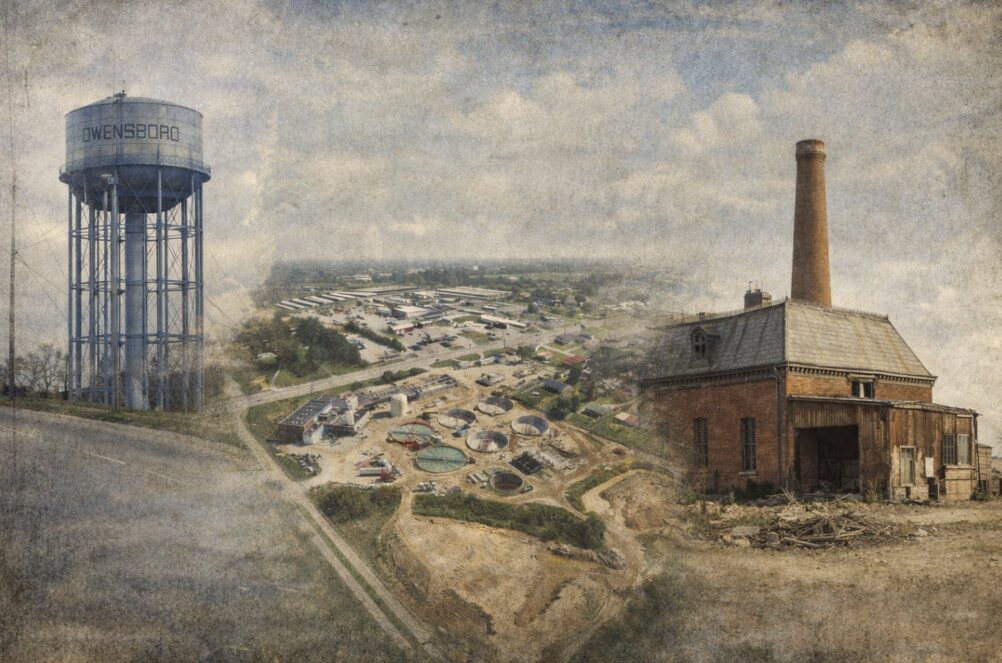
A History of Water in Owensboro: From Private Company to Public Works
This article traces the Owensboro water history from its founding as a private venture in 1878 through nearly a century and a half of public ownership, legal battles, technological advances, and civic determination. It draws on newspaper accounts, city records, engineering reports, and the recollections of those who built and managed the system.
Key Dates at a Glance
| Year | Milestone |
|---|---|
| 1878 | Owensboro Water Company incorporated (private) |
| 1879 | First public demonstration of the waterworks |
| 1888 | Devastating fire exposes system failures |
| 1896 | Water shutoff crisis; city passes rate ordinance |
| 1900 | Citizens vote 1,942–444 to build a municipal water plant |
| 1906 | City-owned water plant begins continuous operation |
| 1911 | Water-softening plant completed — third of its kind in the U.S. |
| 1917 | U.S. Supreme Court upholds private company’s franchise |
| 1922 | Private company’s assets auctioned at courthouse |
| 1923 | Private company formally ceases operation; city takes over all customers |
| 1939 | Combined light and water plant built; old plant abandoned |
| 1940 | New water-softening equipment installed |
| 1947 | Post-war expansion begins with surplus U.S. government equipment |
| 1950 | $900,000 expansion plan approved |
| 1952 | New water treatment plant completed ($711,209) |
| 1953 | Fluoridation begins — 16th city in Kentucky |
| 1971 | Major expansion raises capacity from 14 to 20 MGD |
| 1977 | Geologist warns 21 of 27 wells need replacement |
| 1994 | Bill Cavin Water Treatment Plant dedicated; major main break |
| 1997 | OMU wins four AWWA awards |
| 2017 | 20-inch main bursts at Plant A; boil-water advisory issued |
| 2018 | $45.7 million Cavin Plant expansion begins |
| 2021 | Cavin Plant fully operational; Plant A retired after 115 years |
Part I: The Private Water Company (1878–1899)
A Proposition at the Courthouse (1878)
In the autumn of 1878, Owensboro was a city that drew its drinking water from cisterns. The practice was increasingly viewed as inadequate and unsanitary, but the city’s treasury offered no easy solution — the country was still laboring through difficult economic times. It was under these conditions that Dennis Long of Louisville stood before a gathering of citizens at the Daviess County Courthouse and made a proposition that would reshape the city’s infrastructure for decades to come.
Long’s offer was ambitious. He proposed to build an entire waterworks system — plant, piping, and fire plugs — at his own expense. In return, he asked the city to lease 50 fire plugs at $75 each per year and grant him the exclusive right to supply Owensboro’s water for 30 years. The new system, Long promised, would deliver an abundant supply of clean water for drinking and washing while providing fire-protection pressure equal to four steam engines, rendering the city’s existing fire equipment all but unnecessary.
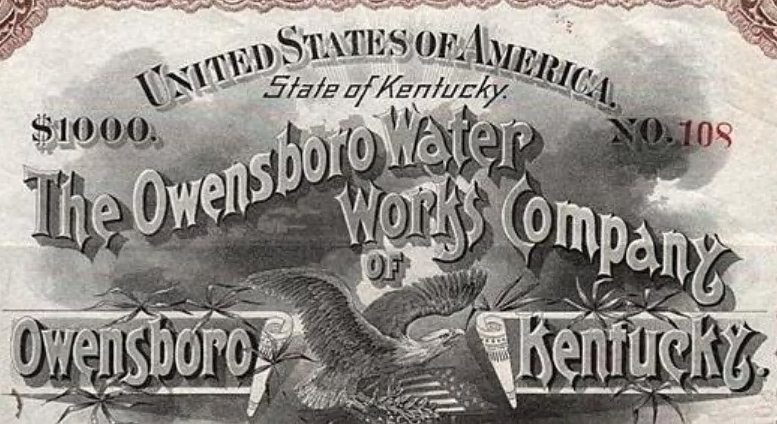
The city government accepted. In September 1878, the Owensboro Water Company was incorporated. The construction contract went to Coverdale & Cowell of Cincinnati, a firm with more than 20 completed waterworks projects to its credit. The Owensboro system would be built on the Holly system, widely recognized for its high-pressure performance and reliability. The project was expected to be finished by January 1879, though construction delays pushed the timeline back several months.
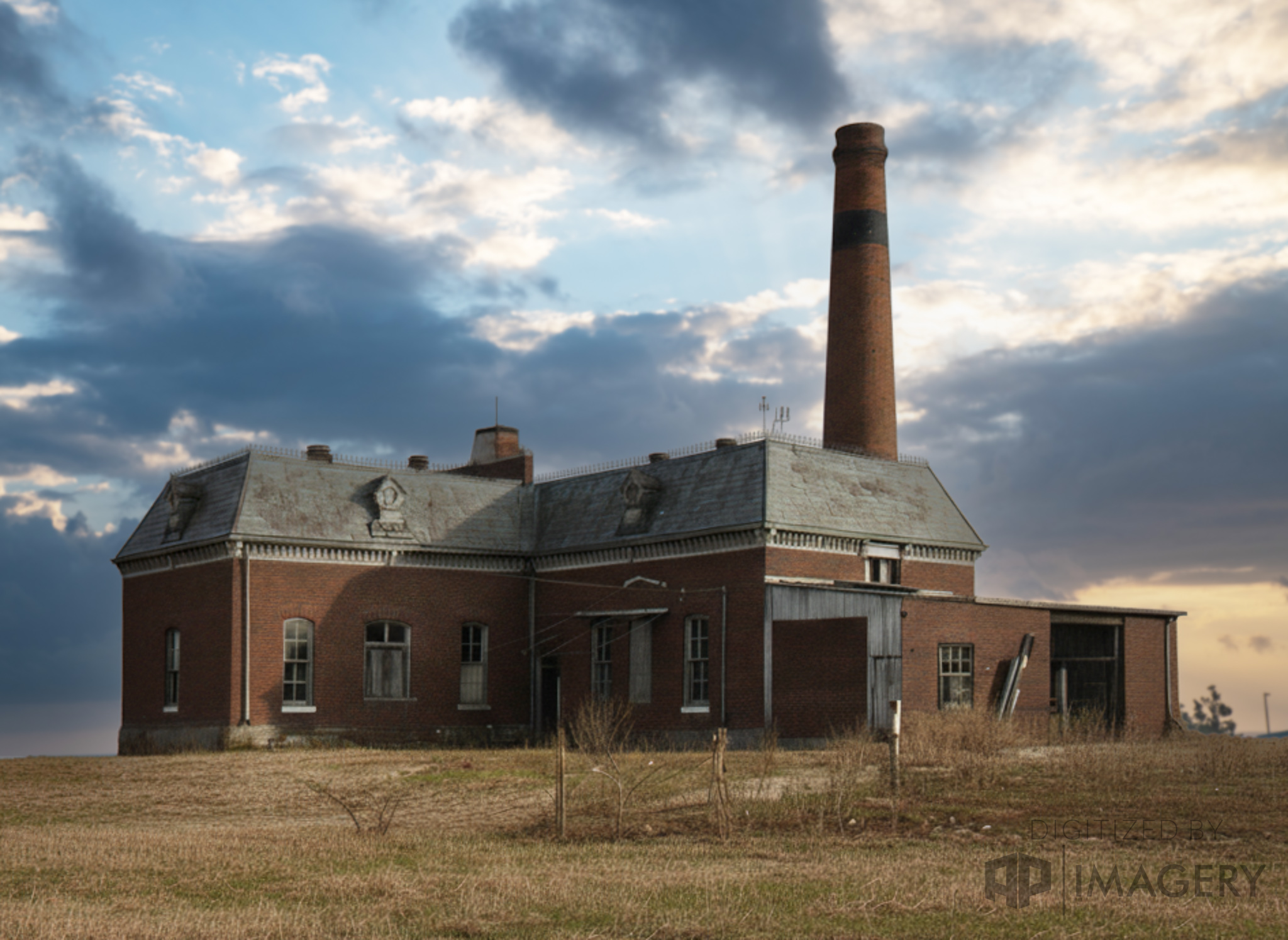
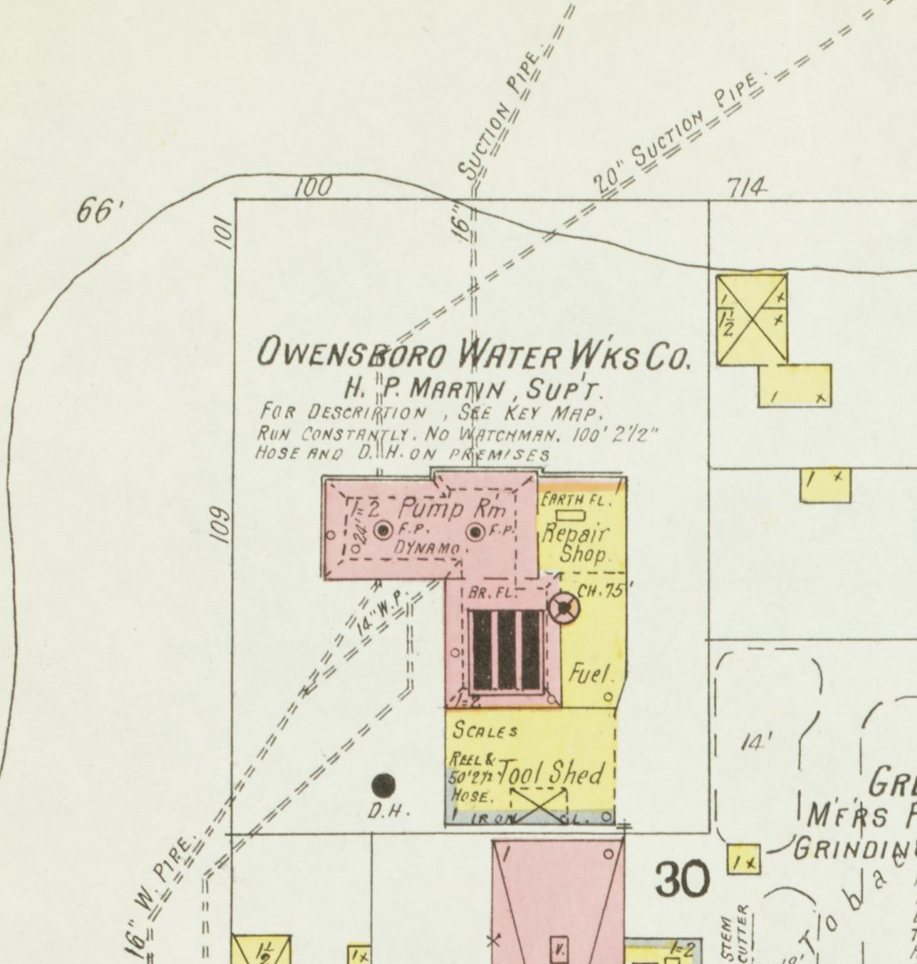
When completed, the plant included two engines and two pumps capable of delivering 2.5 million gallons per day (MGD). The waterworks buildings were substantial brick structures, enclosed by iron fencing and surrounded by landscaped grounds — a source of visible civic pride in this new era of public improvement.
The Public Demonstration (1879)
By July 1879, the system was ready. City officials scheduled a public demonstration to prove the waterworks could perform as promised, and the citizens of Owensboro turned out to see for themselves. The schedule was carefully choreographed:
| Time | Demonstration |
|---|---|
| 1:30 P.M. | 1½-inch stream from hydrant at Main and Frederica streets |
| 2:15 P.M. | Four 1-inch streams from hydrants at Main & Frederica, Main & St. Ann, Main & Allen, and Main & Daviess |
| 2:45 P.M. | 1½-inch stream from hydrant at Fourth and Frederica |
| 3:30 P.M. | 1½-inch stream from hydrant at Frederica and Seventh |
| 4:30 P.M. | 1-inch stream through 1,000 feet of hose from Main and Walnut, followed by additional demonstrations |
Each test confirmed the system’s impressive pressure and reach. Residents were struck by the volume and force of water projected through the hydrants — equal to or surpassing the capacity of several steam engines combined. Local newspapers praised the achievement, and the event marked a major milestone in Owensboro’s public works history.
Discontent, Fires, and Legal Struggles (1882–1895)
Public enthusiasm did not last. Within a few years, the Owensboro Water Company — largely controlled by investors in Louisville — came under fire for prioritizing dividends over the improvement of its system. By March 1882, the city and the company were locked in a contentious dispute.
The conflict began over taxes. The city had granted the company a two-year tax exemption covering 1879 and 1880 as part of the original agreement. Once it expired, an assessment committee valued the company’s property at $100,000 and placed it on the tax rolls. The company objected, arguing its mains were essential public infrastructure and should not be taxed. When the city’s quarterly water rent came due, officials proposed offsetting the company’s unpaid taxes against the payment. The company refused and filed suit.
The city prepared its counter-case by citing the company’s failure to build a standpipe required under the original contract, and by calling residents who had witnessed the waterworks fail during fires. The matter was set for hearing in the Daviess County Circuit Court.
The worst vindication of the public’s fears came in April 1888. A devastating fire consumed one of Owensboro’s finest business blocks, causing an estimated $125,000 in losses — only a fraction covered by insurance. As firefighters battled the blaze, the waterworks failed them:
From the moment the first alarm was sounded and the call placed to the water company, 57 minutes elapsed before water began flowing to combat the flames.
The fire left a landscape of ruins and deepened public anger toward the company. Yet the Owensboro Water Company projected confidence. In March 1889, company officials announced the purchase of a massive 105,000-pound pump designed to serve a population of 30,000, citing the city’s rapid growth. Less than two months later, irony struck: a discharge pipe burst during a fire response, flooding the tunnel to the river, eroding the foundation beneath the north wall, and threatening to collapse the entire structure. The company that had failed the city during fires now found itself a victim of one.
In June 1889, the city adopted an ordinance transferring the contract to a reorganized entity, the Owensboro Water Works Company. That December, the Kentucky Court of Appeals delivered a landmark ruling in B. L. Duncan & Son vs. Owensboro Water Company: any citizen who suffered property damage from fire due to the company’s failure to provide adequate water had the right to sue for damages. The court specifically cited the notorious blaze that began in Fisher’s Saloon and consumed half a block before any water could be obtained.
By the end of the 1880s, the system consisted of 15 miles of mains, 600 taps, 30 meters, and 126 hydrants — respectable numbers that did nothing to restore confidence in a company repeatedly found wanting when the city needed it most.
The Water Shutoff Crisis and Rate Ordinance (1896)
In June 1896, tensions reached a breaking point. Company president Mr. Callaghan ordered superintendent Mr. Martin to cut off water to all customers who had not paid their fees — roughly 50 locations across the city. Before reaching Louisville, Callaghan reconsidered and sent a telegram reversing the order, but the damage was done.
The shutoffs provoked immediate resistance. George W. Jolly and Judge Atchison reconnected their own water after the company cut it off. Company employees retaliated by shutting the water off again and filling the taps with gravel to prevent further reconnection. Jolly and Atchison offered to pay the previous year’s rates; the company refused. Councilman L. P. Birk offered to pay both old and new rates as a compromise; the company still declined.
When Mayor Hickman learned of the situation, he convened an emergency council meeting that same afternoon. By 2:00 P.M., the council had unanimously passed a comprehensive ordinance regulating water prices throughout the city. It established fixed rates for residential, commercial, and industrial users:
1896 Water Rate Schedule (Annual)
| Fixture / Use | Rate |
|---|---|
| Residential Fixtures | |
| Washstand (warm and cold water) | $2.50 |
| Kitchen sink (warm and cold water) | $2.50 |
| Bathtub (warm and cold water) | $2.50 |
| Water closet or privy vault | $2.50 |
| Urinal | $2.50 |
| Residential Dwellings | |
| Four rooms or less, one tap | $3.00/year |
| Each additional room | $0.50/year |
| Lawn sprinkling | $0.02/sq. yard |
| Commercial & Public | |
| Street/lawn sprinkling (per 25 linear ft) | $0.10 + $0.05/add’l ft |
| Stable (per stall, cow, horse, or carriage) | $1.00 each |
| Filling cisterns (per 1,000 gallons) | $0.25 |
| Businesses | |
| Business washstand, urinal, or hydrant | $5.00 |
| Barber shop (first chair / each additional) | $3.00 / $2.00 |
| Blacksmith (first forge / each additional) | $3.00 / $2.00 |
| Billiard hall (per table) | $5.00 |
The ordinance also introduced metered service. Consumers could request a meter at their own expense, with a minimum annual charge of $12.00 for those using less than 48,000 gallons per year. Those exceeding 168,000 gallons would pay no less than $25.00 annually. Meters were to be kept in good repair, read at regular intervals, and the company was required to submit detailed financial reports to the council every six months.
The 1896 ordinance represented a decisive victory for the city council, curbing the arbitrary power of the private water company and establishing the principle of public oversight over an essential service.
Part II: Building a Public Utility (1900–1939)
The Bond Election of 1900
By the turn of the century, Owensboro’s patience with the private company was exhausted. The city council, aware of the problem, knew the company was not going to furnish better water. The firm operated within the bounds of its franchise, and when residents complained about mud in the river water, the company simply pointed to its contract.
After considerable discussion, the council passed an ordinance on October 10, 1900, calling for an election to authorize a $200,000 bond issue for the construction of a city-owned water works. The measure was controversial. The Owensboro Messenger newspaper opposed municipal ownership, warning that new city streets would have to be dug up, that taxation would increase, and that public management could not match private efficiency.
A legal challenge arose immediately. City Clerk W. M. O’Bryan — later mayor — refused to sign and seal the bonds. The city brought suit to compel him. Certain taxpayers also joined the attempt to block the issue.
There was a further complication. As historian W. Foster Hayes recounted in Sixty Years of Owensboro:
“The city and its council had been confronted with this difficulty: Because of certain constitutional provisions and of the already existing indebtedness of the city, the bonds would not have been valid unless it could be shown that the city had a population of 15,000 or more. The federal census of 1900 showed a population of 13,189. The council, advised of this trouble, had another census taken… By this census the population was ascertained to be on Aug. 1, 1900, ‘15,509 souls,’ and by an ordinance of October 10, 1900, that was officially declared to be the population of the city.”
The suit to compel the clerk to sign was decided in the city’s favor by the Circuit Court and upheld unanimously by the Court of Appeals on June 11, 1902.
Election day — November 6, 1900 — arrived amid national drama. McKinley and Bryan contested the presidency. Seven shootings were reported across Kentucky. The Messenger devoted its post-election coverage to national results and made no mention of the bond vote. It remained for Hayes, writing more than fifty years later, to record what happened:
“When the election was held, Nov. 6, 1900, it transpired that these apprehensions [concerning municipal ownership] were not shared by any great number of our citizens, and the bond issue was approved by a vote of 1,942 as against 444 opposed. The bonds were presently issued pursuant to an ordinance Dec. 3, 1900.”
The people of Owensboro had spoken decisively. The era of private water was drawing to a close.
Reorganization and the Last Stand of the Private Company (1901–1903)
By January 1901, the old Owensboro Water Works Company was struggling. Public dissatisfaction persisted, and the city’s impending municipal system posed an existential threat. In April 1902, the company underwent a complete reorganization. A new ownership group — mostly local citizens and taxpayers — took control and immediately cut water rates by 25 to 33 percent. A modern five-room home that previously paid $24 a year now paid $15.25, nearly a 30 percent savings.
Management pledged equitable billing and refunds for overpayments. But the reforms came too late. In September 1903, the company filed suit in the United States Court, arguing that the city’s plan to issue $200,000 in bonds for a competing municipal system violated its exclusive franchise. The case, overseen by Judge J. J. Sweeney and argued by attorneys W. T. Ellis, Clarence M. Finn, and Judge J. D. Atchison, sought an injunction blocking the city from building its own water plant.
The clash between private enterprise and the growing municipal-ownership movement had reached its decisive moment.
Building the City’s Water Plant (1904–1906)
The city pressed ahead. By August 1904, construction of the new municipal water plant was well underway. Of the sixteen deep wells planned for the system, eight were piped and ready. Each well used a 2-inch air pipe enclosed within a 3-inch water pipe, with compressed air forcing water to the surface. An initial test of a single well delivered more than 2,000 gallons per minute — projecting a total capacity of 32,000 gallons per minute from all sixteen wells.
Two large reservoirs, each holding 5 million gallons, were planned for a hill beyond the residence of H. E. Rose, about forty feet above the city’s general elevation. This natural advantage meant gravity could assist distribution, reducing reliance on mechanical pumping.
By June 1905, crews began laying distribution pipes at Third Street and Leitchfield Road, extending toward Main Street and then along Main to Triplett Street. Along Frederica Street, workers made an inventive decision: rather than tearing up the recently paved road, they laid the pipes in the grass plots on either side, filling the trenches with dirt from the road edges. The approach was practical and efficient, preserving the new asphalt while minimizing cost.
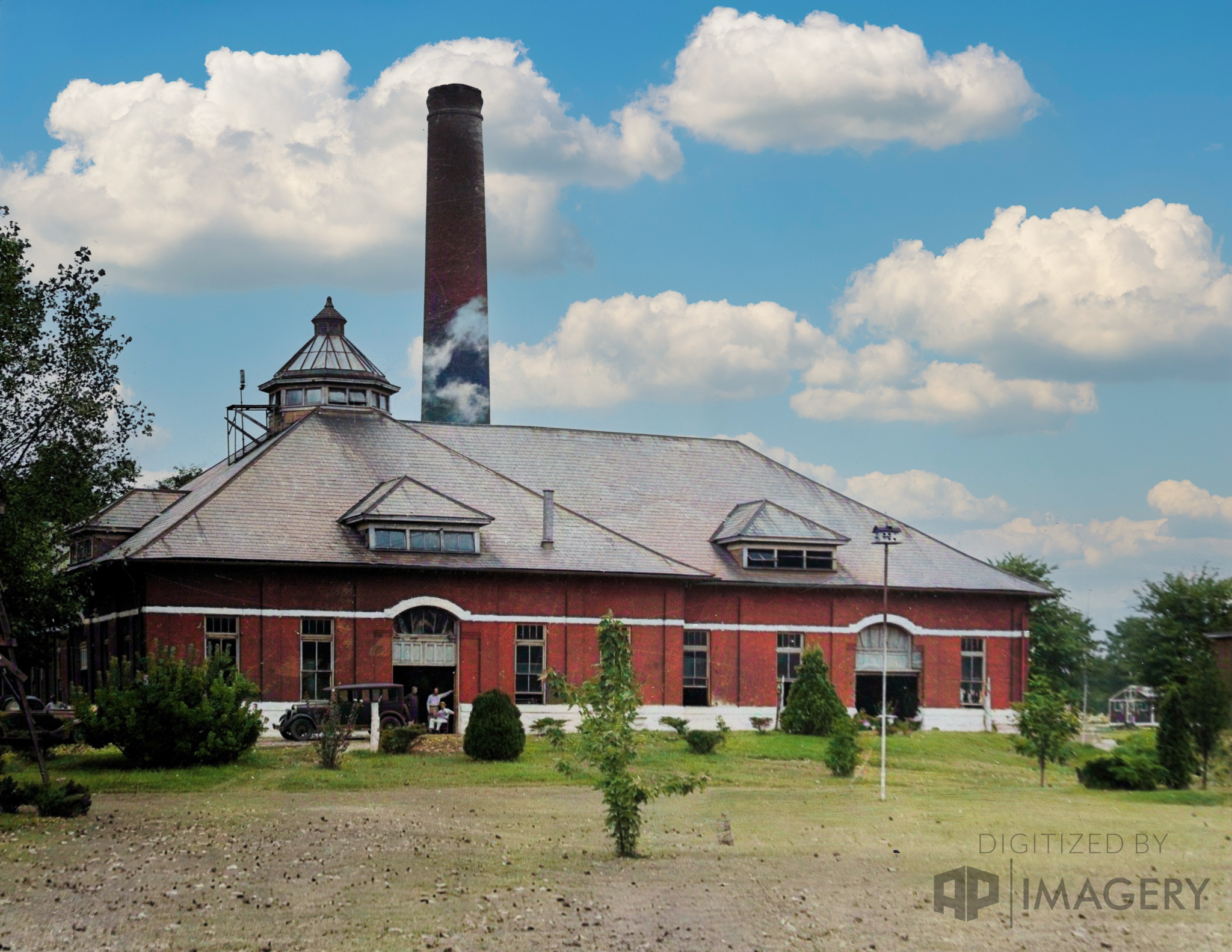
On a July day in 1906, Mrs. W. M. O’Bryan — wife of the very mayor who, as city clerk six years earlier, had refused to sign the bond issue — had the honor of turning on the steam for the first test of the new municipal water plant. The compressors lifted water successfully from the system’s 13 deep wells.
Later that month, a gasket failure prompted rumors of management problems, but operations continued without interruption. In early August, the fire department tested pressure by connecting seven hose lines to hydrants around the courthouse square and at First and St. Ann Streets. The streams rose several feet above the courthouse tower, demonstrating pressure and reliability that the private company had never achieved.
On August 18, 1906, the Owensboro municipal water plant began continuous operation. By early September, Superintendent E. H. Breidenbach reported 175 homes connected, with 275 more planned in the coming weeks.
The total cost of constructing the plant and installing the distribution system came to $359,434.55. Of this, $200,000 came from bonds issued January 1, 1901; $60,000 from bonds dated January 1, 1907; and the remaining $99,434.55 was spent from the city’s general revenue fund.
After nearly three decades of frustration with private ownership, Owensboro had achieved independent control of its water supply.
Legal Challenges and Early Expansion (1907–1908)
The private company did not yield quietly. In March 1907, the Daviess County Circuit Court issued a permanent injunction against the city in an equity case filed by the Owensboro Water Works Company, confirming the company’s right to continue operating under its franchise.
The city focused on what it could control: expanding service. A $60,000 bond issue in 1906 and a $25,000 bond sale in 1908 funded the extension of mains to all parts of the city. By April 1908, Mayor O’Bryan and the council had also installed public watering troughs for horses at key intersections — Fourth Street and Leitchfield Road, Triplett Street on Hartford Road, Twelfth Street, and Frederica Street — reflecting the city’s broadening attention to civic infrastructure.
The administration that oversaw the completion of the plant included Mayor W. M. O’Bryan; Mayor pro tem Steitler; City Attorney Jolly; City Engineer E. B. Shifley; and Superintendent E. H. Breidenbach. The twelve councilmen representing the city’s four wards included Dr. E. B. McCormick, George Mischel, D. C. Stimson, J. P. Davis, Charles Deuser, Dr. S. Lambert, Dr. D. M. Griffith, John Hafendorfer, Steitler Jr., Felix Bennett, J. Ed Guenther, and J. W. McCulloch.
River Pollution and the Case for Clean Water (1911–1912)
By the early 1910s, concerns about regional water safety were mounting. In September 1911, chemist Jay Allen Cravens and colleague J. C. Diggs embarked on a scientific expedition to analyze pollution in the Ohio River. Working from a small vessel outfitted with a portable laboratory, they collected water samples at one-mile intervals along the river. Arriving at the St. Ann Street levee on a Friday evening, they spent several days conducting analyses in Owensboro.
The expedition, sponsored by the Indiana Board of Health, followed Indiana’s passage of legislation prohibiting sewage discharge into the Ohio River — a law that would not take effect until Kentucky adopted a similar statute. Early findings revealed widespread contamination, challenging the common assumption that water between cities remained germ-free.
Cravens and Diggs visited both the municipal plant and the old private company’s plant, taking samples from the city’s deep wells, the company’s river-based system, and additional sources at the Glenmore Distillery and the Daviess County Planing Mill. Although Cravens initially remarked that preliminary chemical results showed “little difference” between the two supplies, the comparison was misleading. The city’s deep-well water was harder but far cleaner. The private company’s river supply — filtered through a sand bar — was softer but carried significantly higher health risks from upstream contamination.
In January 1912, Indiana State Chemist Dr. H. E. Barnard confirmed the danger. His studies between Cincinnati and Evansville revealed typhoid bacteria in alarming quantities. He condemned the practice of cities discharging sewage into the river and urged adoption of modern filtration and treatment systems.
The Water-Softening Plant (1910–1912)
The municipal system’s greatest competitive weakness was hardness. The city’s deep-well water, rich in calcium and magnesium, was safe but punishing on laundry, plumbing, and industrial equipment. Large consumers — railroads, factories — favored the private company’s softer river water. Some residents even switched back to the private system, creating a direct competitive threat.
In September 1910, the city council introduced an ordinance authorizing $20,000 for a water-softening plant. The measure initially met resistance but passed with detailed provisions governing design, capacity, and construction bidding. Contracts were awarded in June 1911 for excavation, concrete foundations, building construction, and mechanical equipment.
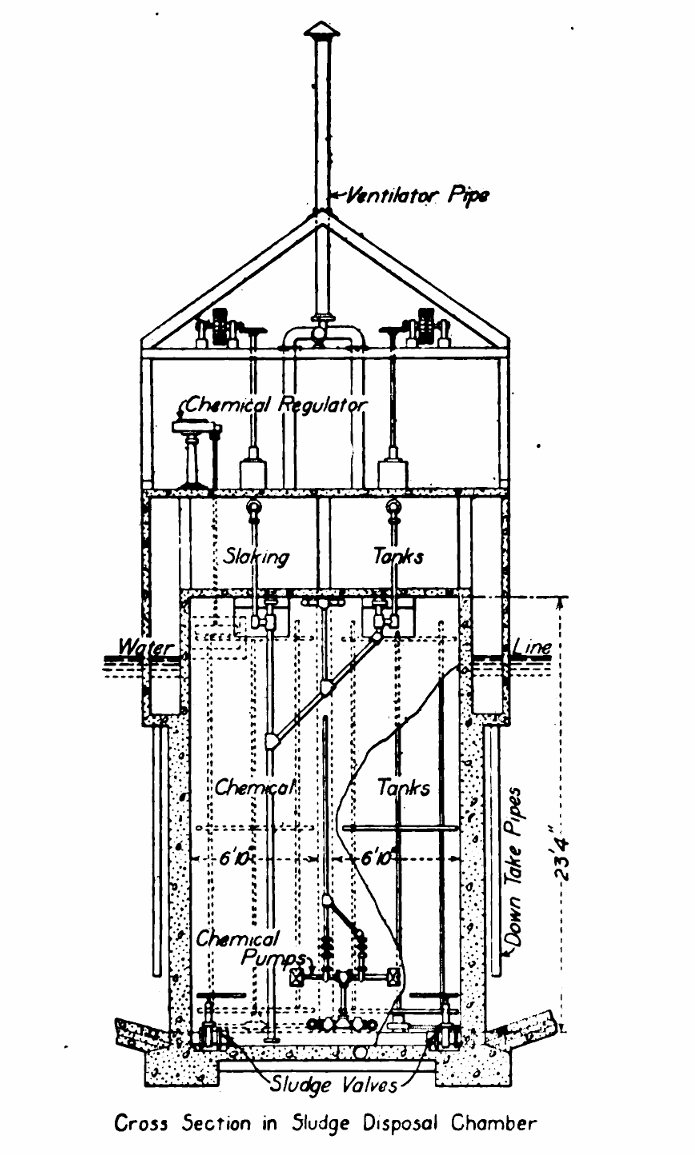
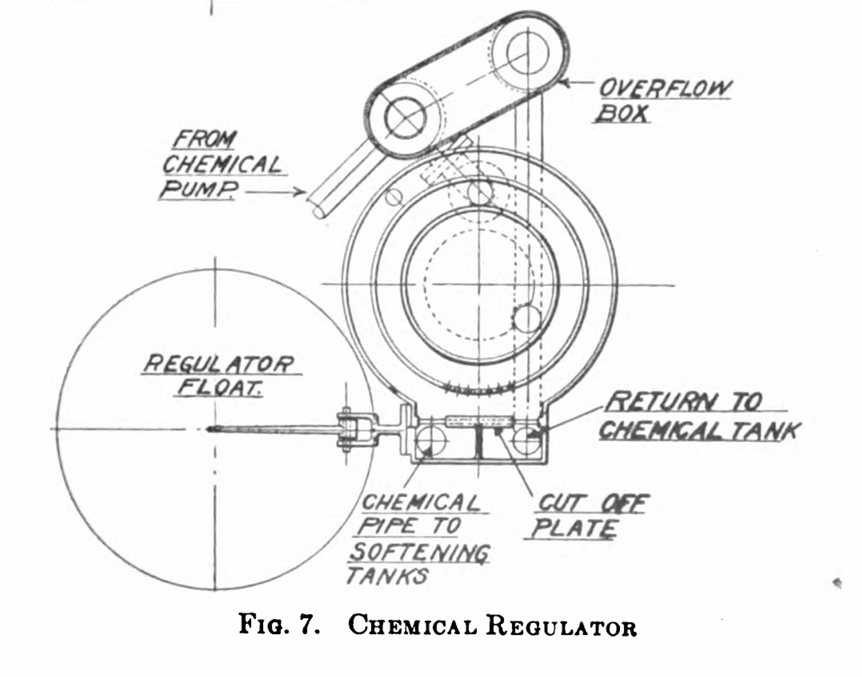
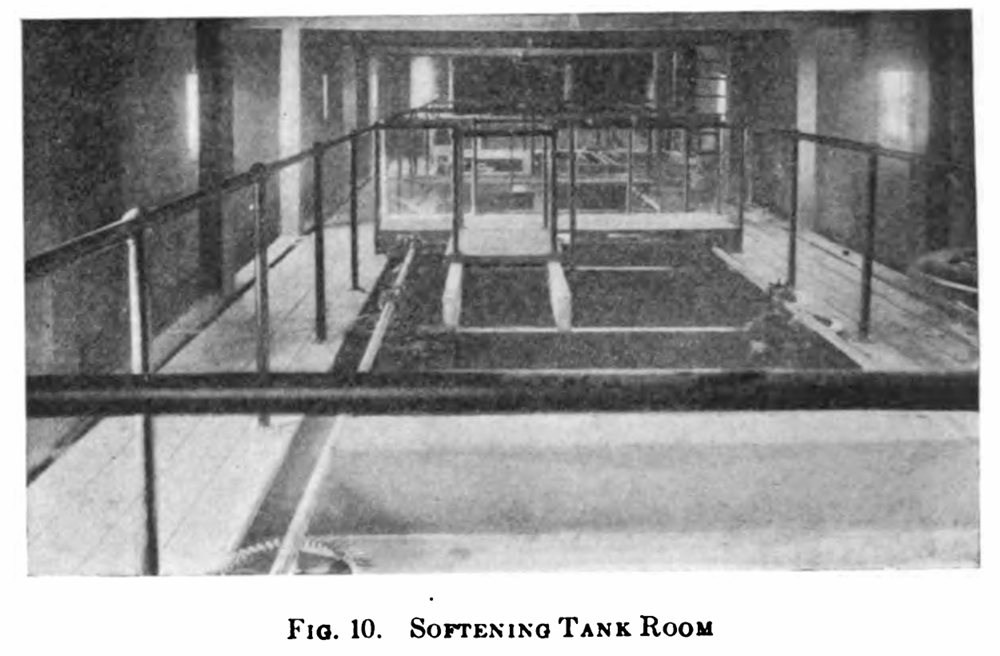
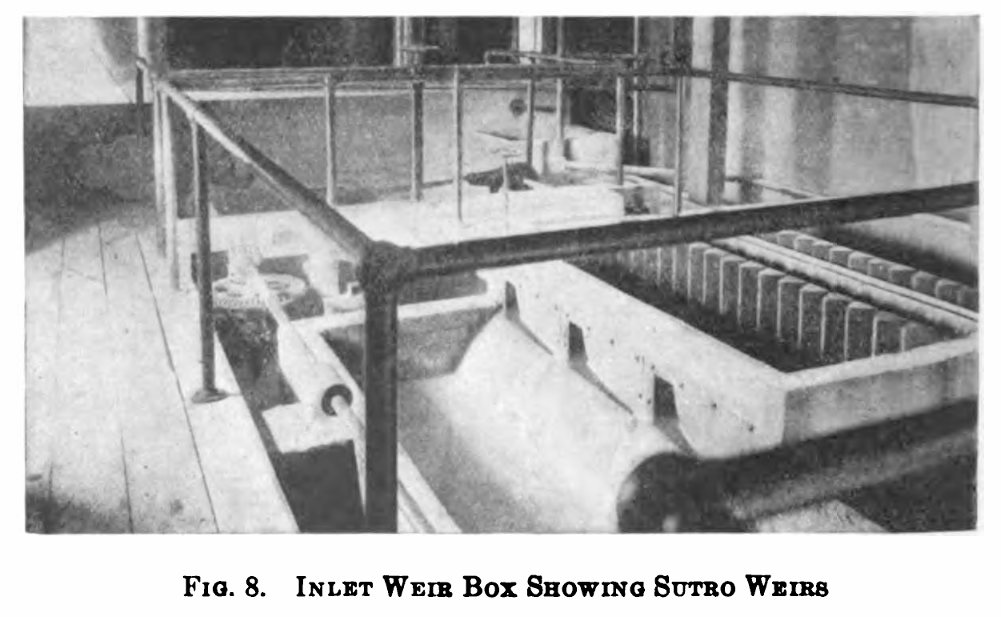
The softening plant was completed and placed into operation in December 1911. It was the third of its kind in the United States, after plants in New Orleans and Columbus, Ohio. The system used a process imported from Germany, where water had been softened for several years using the cold lime-soda process. The plant consisted of three principal sections: chemical tanks and regulators, softening tanks where raw water was treated with purifying agents, and sedimentation basins. Water flowed through an inlet weir box into softening tanks, then passed through a series of Sutro weirs, each capable of processing 1 MGD. The system operated largely automatically, requiring only one worker per shift.
Results were immediate. At the 1912 Annual Convention of the American Water Works Association, Superintendent Breidenbach reported that raw well water measured approximately fourteen degrees of hardness, but after treatment averaged just 3.5 degrees. Even rainwater collected in Owensboro registered about four degrees — demonstrating the remarkable effectiveness of the softening process.
Within six months, boilers at the municipal electric and water plants showed dramatic improvement: old scale deposits had loosened and detached, with no new scaling forming. Local ice manufacturers reported producing noticeably clearer product. The total cost was $28,380.31, and during its first months the plant treated over 241 million gallons at an average cost of $6.58 per million gallons.
The success of the softening plant was due largely to a group of civic-minded business leaders who had championed public ownership from the start. Their vision produced a utility managed by a non-partisan, unpaid, three-member commission appointed by the city council for staggered three-year terms.







Financial Assessment and Engineering Review (1914)
In March 1914, Mayor Hickman received an extensive report from Engineer Phil Burgess evaluating both the physical condition and financial performance of the waterworks. Burgess identified several concerns: the high cost of operating the air-pumped wells, the limited quality of water without additional purification, and the need for financial restructuring.
His recommendations included reducing pump operating hours, drilling additional wells into gravel strata, studying the feasibility of drawing water from the Ohio River, upgrading the softening system, and installing a steam-turbine-driven centrifugal pump for fire protection. The report urged officials to balance fiscal responsibility with continued modernization.
The Supreme Court Settles the Franchise (1917)
In March 1917, the United States Supreme Court rendered a decision that concluded one of Owensboro’s longest legal conflicts. The Court upheld a lower-court ruling granting the private Owensboro Water Works Company a perpetual injunction preventing the city from interfering with its franchise operations. The ruling confirmed the company’s right to lay mains in city streets, continue operating its system, and maintain its corporate existence.
The litigation had escalated after the city council passed a resolution on July 6, 1914, directing officials to notify the company to cease excavating in public streets and alleys. The company sued, arguing the city was attempting to revoke its franchise and confiscate its property. Judge Walter Evans of the U.S. District Court for the Western District of Kentucky ruled in the company’s favor. The city appealed to the Supreme Court, which affirmed the decision.
Despite losing in court, the city’s municipal system continued to gain customers and strengthen its financial position. A recent house-to-house canvass had produced encouraging results, and officials remained confident in the city plant’s long-term viability.
Water Treatment Improvements (1918–1919)
A detailed 1918 report outlined the state of Owensboro’s water treatment. A carbonating plant had recently been installed, successfully removing about ninety percent of the lime that otherwise would have clogged distribution pipes. The water-softening plant was processing approximately 3 MGD, with capacity for up to 5 MGD.
The report recommended enlarging the plant for increased demand, replacing worn pinions on the mixing tanks, cleaning the air compressor’s condenser, and equipping all boilers with soot blowers that a previous administration had removed. The boiler system — three 200-horsepower units of poor design — was in rough shape, with two in particularly bad condition.
On the positive side, a new electrically driven pump with 4 MGD capacity had been installed, providing backup capability through the electric light plant if the steam plant failed. A new Wills propeller centrifugal pump was also functioning successfully.
By the end of 1919, public debate turned to the financial condition of the waterworks. The municipal plant had been operating at a loss, prompting calls for rate adjustments and self-sustainability. Some residents suggested purchasing the old private plant to eliminate competition. Others argued the system was never intended to generate profit — it existed to protect taxpayers from poor service and inflated rates. Officials urged equitable rates, a sinking fund for future needs, and impartial enforcement of charges for all consumers.
Rate Adjustments (1920)
In January 1920, Engineer Philip Burgess recommended approximately doubling the water rates. Rising operational costs and recurring deficits had placed the system under financial strain. The increase was intended to eliminate the annual shortfall, create a sinking fund, and prepare the plant for growing demand. Existing rates were widely described as “ridiculously low.”
The new rates took effect February 1, 1920, with the stipulation that surplus revenue should not be diverted to unrelated city projects. The water plant, officials insisted, belonged to the people, and its revenues should be used solely for operation, maintenance, and improvements.
The End of Private Water (1921–1923)
In the summer of 1921, the Owensboro Water Works Company entered its final decline. Its president, James J. Sweeney, died suddenly, and with him went the personal determination and financial backing that had kept the company alive. Sweeney had endorsed bank notes totaling more than $27,000 to sustain operations.
The company — originally built by Dennis Long & Co. and later managed by the Long, Miller, and Callahan families before passing to W. N. and J. J. Sweeney — had been losing customers for years. A rate war between the two systems had kept prices low for consumers, benefiting manufacturers and commercial buildings, but the municipal plant steadily gained ground. By 1921, the old company had lost nearly all its customers while the city plant served more than four thousand.
Efforts to sell the private plant to the city failed over valuation disputes. City Engineer E. B. Shifley estimated the municipal plant, with all improvements, was worth around $500,000 — a figure that underscored the contrast between the thriving public system and the collapsing private one.
On May 18, 1922, the trustee of the bankrupt estate announced a public auction for June 7, 1922, at the courthouse door. All real and personal property, including franchises and rights, went to the highest bidder. The following year, in 1923, the old company formally notified the city that it was going out of business. The city assumed its remaining customers, spending $15,000 in the transition. Nearly half a century of private waterworks in Owensboro was over.
The Struggling Twenties (1922–1929)
With the private company gone, the municipal system was Owensboro’s sole water provider — but it was not self-sustaining. Despite sharp rate increases, the water plant could not cover its own costs. The electric power plant subsidized the water department to the tune of $35,000 to $40,000 a year. An additional $12,000 had been spent extending service connections to new parts of the city and absorbing the old company’s former customers.
An October 1922 financial analysis laid bare the situation. The water department’s income could not meet operating expenses even before debt service. A fifty percent rate increase, the analysis concluded, would still not make the water plant fully self-sustaining given the enormous increases in fuel and freight costs since the war.
In June 1923, discussion turned to a proposed $100,000 bond issue for extending water service to underserved areas of the city. The debate in the Messenger-Inquirer centered on accountability:
“Who is going to spend the money? Will it be spent by the same men who will spend the money before looking into other things… It is the business sense to find out first, not after.”
A May 1924 retrospective in the Messenger-Inquirer painted a more optimistic picture. By then, the combined electric and water utilities were valued at fully $2,000,000. The article noted that “in few cities the size of Owensboro, throughout the length and breadth of the land, can such fine public utilities be found.” By 1915, the city had invested $457,246.15 in the water plant alone. The softening plant had reduced water hardness “appreciably,” and the old private company had begun losing customers at a rapid rate once softer municipal water was available.
But infrastructure challenges persisted. The softening plant, originally designed for 1 MGD, was being pushed well beyond its capacity. By 1939, some of the older 4-inch mains had become completely stopped up with lime deposits — a consequence of years of water that, despite softening, still carried enough mineral content to slowly choke the distribution system.
In June 1926, a minor episode illustrated the political dynamics of the era. The city re-advertised bids for coal to fuel the water plant after rejecting all initial submissions. The M. and O. Coal Company won with a bid of 7.75 cents per bushel — the cheapest coal the water plant had purchased in years. Competitor V. J. Steele Coal Company, whose bid was slightly higher, engaged legal counsel to contest the award. Commissioner Stone defended the M. and O. Company for its loyalty in supplying coal “in times of stress at prices far under the then prevailing market quotations.”
In August 1929, Dr. S. E. Hainline conducted a survey of the water plant and found it in excellent condition. The chlorinated lime used as a typhoid preventive — applied every year from August through September — gave the water a noticeable odor that drew complaints from residents. Dr. Hainline invited those who noticed the odor to visit the plant and see the sterilization process for themselves. He also ordered inspections of bakeries, soda fountains, and groceries across the city. In a sign of the times, he noted that malaria was reported around the Rome neighborhood due to mosquitoes, and ordered the lagoon in Chautauqua Park oiled as a preventive measure.
Depression-Era Operations (1930–1936)
During the hot, dry summer of 1930, the plant faced one of its greatest operational challenges. The city, which typically produced about 3.5 MGD, struggled to maintain pressure during a particularly arid week as demand surged in the southern and western sections. Eighteen electric and steam-driven pumps worked continuously, drawing water from deep wells. Two new pumps installed the previous year, each capable of 6,500 gallons per minute, helped the system hold.
By 1931, mains had been extended along Griffith Avenue and into newly annexed neighborhoods. In 1932, the system recorded 7,500 total connections — 6,000 on flat rates, 1,500 metered. City officials encouraged wider meter adoption, arguing it reduced waste and stabilized revenue.
The wages of the era reflected the Depression’s grip:
Water Plant Wages, 1932
| Position | Pay |
|---|---|
| Chief Engineer | $33/week |
| Watch Engineers | $0.50/hour |
| Maintenance Men | $0.40/hour |
| Regular Firemen | $0.35/hour |
| Ash Haulers / Service Men | $0.30/hour |
| Laborers | $0.25/hour |
| Softening Plant Operators | $20/week |
| Foreman | $22.50/week |
| Superintendent of Light & Water | $3,300/year |
| Water Department Bookkeeper | $1,020/year |
| Chief Clerk, Light & Water Office | $1,200/year |
Through the early-to-mid 1930s, Commissioner R. E. Miller led efforts to strengthen the distribution system. Following recommendations from the state actuarial bureau, the city installed a new main extending from the Fourth Street water plant eastward to Seven Hill and westward to Ninth and Triplett Streets. The project enhanced pressure in newly annexed areas and introduced redundancy — the older main could now be shut down for maintenance without disrupting service.
By 1933, Superintendent Adam Bishop oversaw a plant with 28 wells powered by steam, compressed air, and electric turbine pumps, achieving a total capacity of 5.5 MGD. For fiscal year 1936, the water works reported income of $102,184.99 — the highest since 1931. Operating expenses before depreciation totaled $81,871.37. After depreciation of $3,714.87, the department showed a net operating loss of $9,297.76. Despite this, officials emphasized the system remained sound. Approximately 6,000 customers were connected, though only 2,700 had meters.
The Combined Plant (1939)
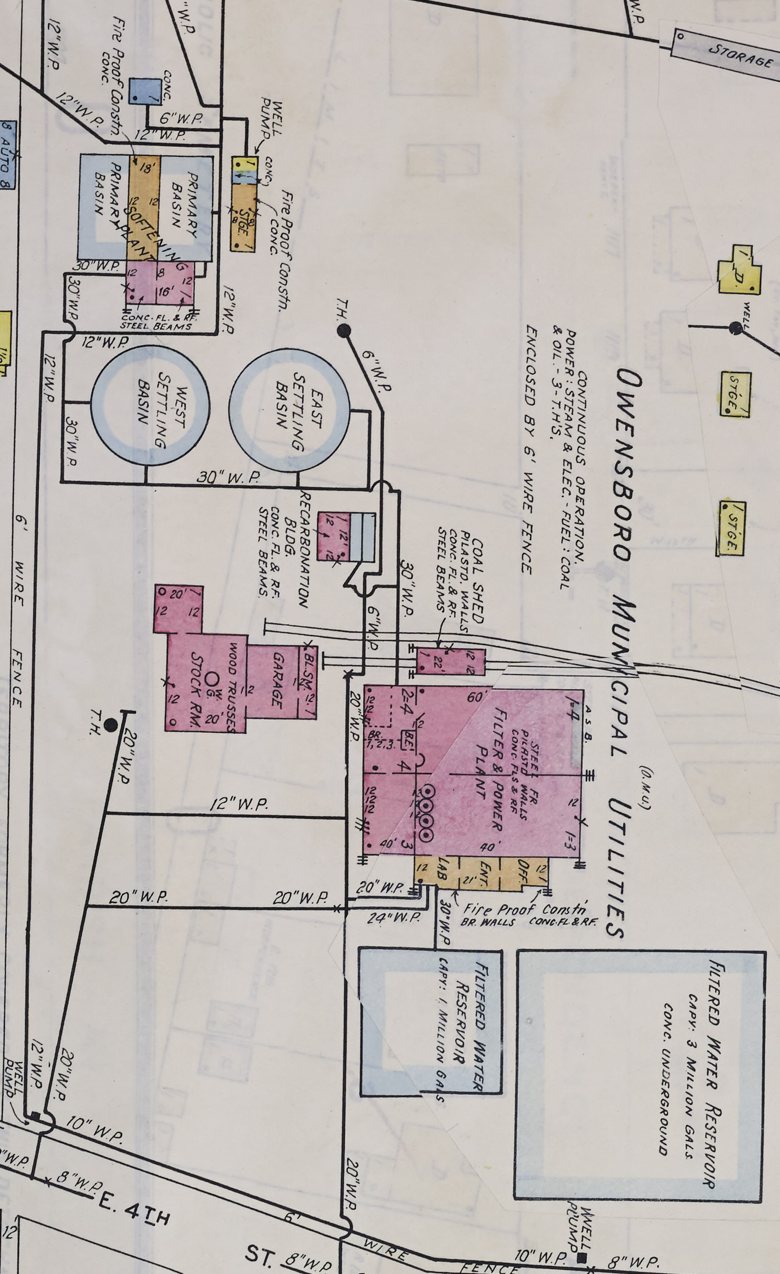
In 1939, a major transition reshaped Owensboro’s utility operations. The city constructed a combined light and water plant, abandoning the original facility that had served since 1906. All high-service pumping was installed in the new building. The old softening plant, designed decades earlier for 1 MGD but long overtaxed, was redesigned for a capacity of 2.5 million gallons. The two old reservoirs, each holding a million gallons, were converted into primary and secondary settling basins.
The new building housed three rapid sand filters designed for 4.5 MGD, a million-gallon underground reservoir, and an elevated tank in the west end of the city holding an additional million gallons (filling automatically when four-fifths full). The consolidation marked the end of the original plant era and set the stage for the wartime and post-war expansions that followed.
Part III: War, Modernization, and Growth (1940–1970)
New Softening Equipment and Wartime Demand (1940–1942)
In the spring of 1940, the city installed new water-softening equipment at the combined plant, further improving the quality and consistency of the treated supply. The upgrade came just in time. With the nation’s entry into World War II, Owensboro’s factories expanded production to support the war effort, increasing water consumption across the system.
A statement of operations for the fiscal year ending February 28, 1942, documented the water department’s wartime performance:
| Water Department — FY 1941–42 | Amount |
|---|---|
| Sales | $139,388.14 |
| Operating Expenses | $64,207.61 |
| Operating Profit | $75,180.53 |
| Net Profit | $28,761.09 |
| Total Investment in System | $1,528,161.15 |
| Daily Capacity | 8,172,000 gallons |
| Yearly Production | 840,730,000 gallons |
The water department was now a profitable operation — a far cry from the chronic deficits of the 1920s. Daily capacity had grown from the original 2.5 MGD of the 1906 plant to over 8 MGD, and the system was producing nearly 841 million gallons per year.
The Utility Surplus Controversy (1944)
On a Friday night in January 1944, the City Utility Commission voted to stop transferring surplus earnings from the light and water departments to the city’s general revenue fund. The practice had quietly funneled approximately $20,000 per month from the utilities into the city treasury. Mayor Fred Weir and Commissioner William T. Young met with City Attorney W. K. Kirtley to discuss the city’s options for seeking relief in court.
The crisis had been triggered by a legal opinion from attorney Wilbur K. Miller of Cary, Miller and Kirk, who expressed “grave doubts” about the legality of the transfers. Revenue bonds, Miller argued, did not authorize payments to the city for general purposes. Auditors Brown and Imhof of Louisville examined the books and found that the city had overdrawn approximately $130,000 from utility funds beyond what was permitted.
Commissioner Young, who served as finance commissioner, noted that the utility board had recently expected to withdraw $50,000 for a proposed new airport. The commission — chaired by Norman Cox and including Aubrey Gipe and William O’Bryan — ultimately decided that the safest course was to halt all transfers until the matter was resolved by the courts or the legislature.
The episode revealed the tension that would recur throughout OMU’s history: the temptation for city government to treat the utility’s revenues as a general fund, versus the utility’s mandate to reinvest in its own infrastructure.
Crossing the Million-Dollar Mark (1945)
By the end of the war, the combined light and water departments had crossed the million-dollar mark in total operations. The utility was now overseen by Commissioners W. P. Young, Aubrey Gipe, and Harry Holder Jr., with Charles Smith serving as General Manager and Elmer Smith as plant superintendent. The department maintained careful accounting of its operating fund, revenue fund, renewal and replacement reserves, and bond funds — a far more sophisticated financial structure than the simple ledger books of the 1920s.
Post-War Expansion (1947–1950)
In 1947, a new modernization program began when the city purchased surplus equipment from the United States government — a practical use of war-surplus materials that allowed upgrades at reduced cost. Two years later, a three-million-gallon clear-well reservoir was installed. A complete modern mixing plant with a capacity of 10 MGD followed, along with a new aerator and larger purifying equipment. The old reservoirs were revamped as secondary settling basins, and four new rapid filters with necessary main extensions were installed.
By June 28, 1950, the utility commission formally accepted plans for a $900,000 expansion of the water treatment plant. Consulting engineers Black and Veatch of Kansas City prepared the designs, receiving $10,000 for their work. Ed Farmer of Black and Veatch presented the expansion program at a commission meeting attended by Mayor Fred L. Weir, City Commissioners LeRoy Woodward and O. E. Meredith, and City Attorney George S. Wilson Jr.
Plant Superintendent Elmer Smith explained that the existing softening plant, originally designed in 1911 for 1 MGD, was now being asked to handle more than 6.5 MGD — far beyond its intended capacity. The expansion would include a new chemical building east of the existing settling basins, new aerators for the purification process, a sand filter, a new 36-inch circulating water line, and new primary settling tanks. The target was a delivery capacity of 8 MGD.
At the same meeting, the commission approved a contract with Layne-Central Company of Memphis for drilling two new wells capable of producing 500 gallons per minute each, later extended to include two additional wells. Farmer estimated 18 months to completion once construction began.
The New Treatment Plant (1952)
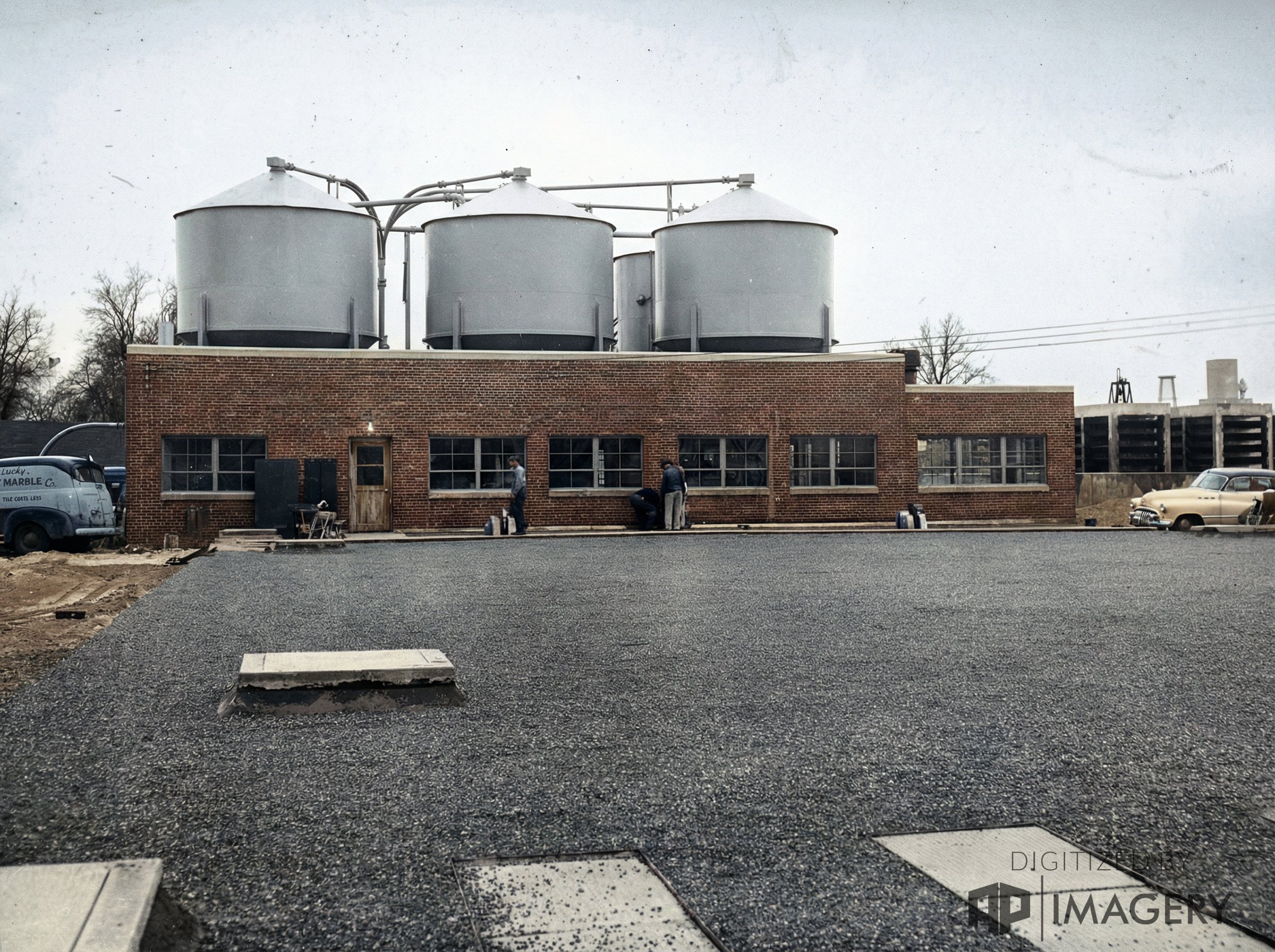
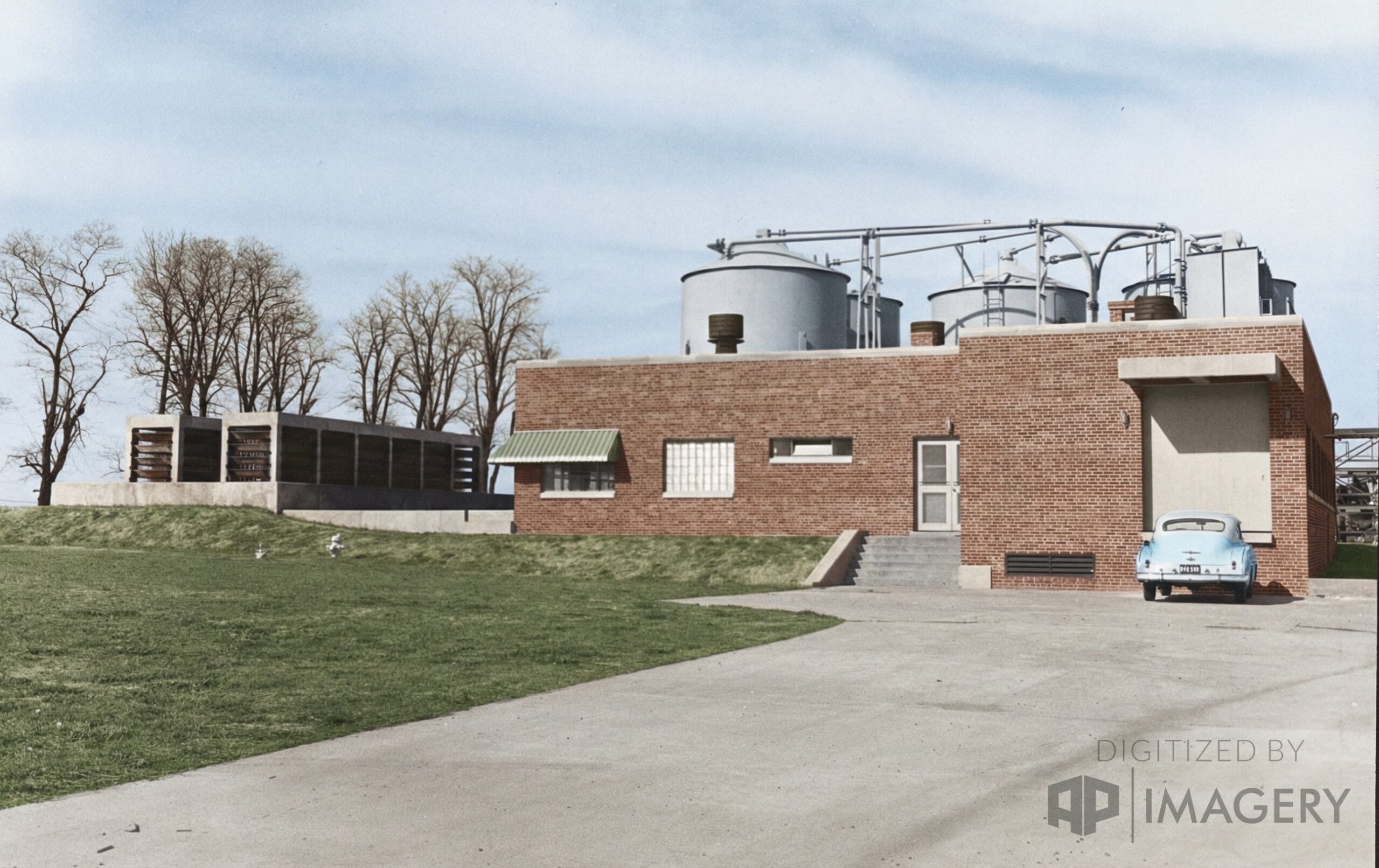
In 1952, the new water treatment plant was completed at a total cost of $711,209. The improvement built upon the 1940 softening system, which had reduced hardness from 350 parts per million (ppm) to about 180. The new facility brought that figure down to approximately 125 ppm — a 71 percent reduction from raw water.
The treatment process began with water drawn from the city’s wells, passed through layers of coke to remove hydrogen sulfide, then treated with soda ash — more effective than the lime process used in previous decades. Additional stages included rapid sand filtration and chlorination to remove suspended solids and eliminate bacteria.
Residents noticed the difference immediately. Citizen Bruce Tippin and others reported needing less soap for washing and laundry. The city opened the facility for public tours, demonstrating its commitment to transparency in managing the community’s water supply.
Fluoridation (1953)
On September 18, 1953, a new fluoridation system went into operation at the Owensboro Municipal Utilities plant. Fluoride was added at a rate of 14 parts per million gallons of water, approximately 84 pounds per day. Plant Superintendent Elmer Smith announced the news, noting that authorities had withheld the information for a reasonable period to avoid a storm of calls about changes in the water’s taste — a procedure followed by municipalities across the country.
Owensboro became the 16th city in Kentucky to fluoridate its water supply, and approximately the 800th in the nation. Other Kentucky cities already using fluoride included Mayfield, Hopkinsville, Central City, Franklin, Glasgow, Elizabethtown, Greensburg, Lancaster, Versailles, Ashland, Raceland, Paintsville, Martin, and Louisville. Two Kentucky towns — Horse Branch and Horse Cave, in Ohio and Hart counties — had found it unnecessary because their natural water already contained the chemical.
In November 1953, Nick G. Johnson, assistant director of the State Division of Public Health Engineering, inspected the system and gave it a favorable report. The plant superintendent was now Angelo Stone, who operated the system with complete chemical laboratory control. Mayor LeRoy Woodward announced the results, and the fluoridation equipment — a dust filter, feeder unit, and chemical storage room — was declared properly installed and in excellent condition.
Fifty Years of Public Water (1955)
In January 1955, the Messenger-Inquirer published a comprehensive retrospective on the water system’s first half-century of public ownership. The article traced the full arc from the contentious 1900 bond election through the 1950s modernization, drawing on city records and W. Foster Hayes’s Sixty Years of Owensboro.
The piece recalled the political drama surrounding the system’s founding — the hostile editorials in the Messenger, the city clerk who refused to sign the bonds, the creative census that proved Owensboro’s population exceeded 15,000. It documented every mayor, council member, and engineer who served during the critical years from 1900 to 1908.
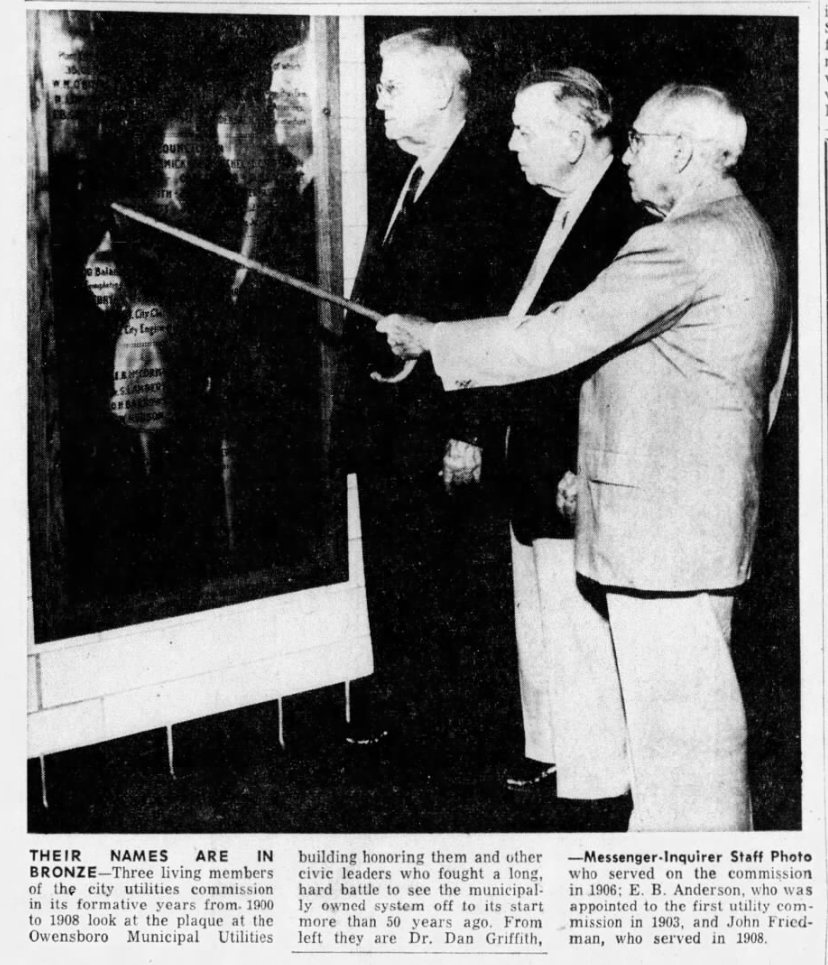
A photograph accompanying the article showed three surviving members of the original utility commission — Dr. Dan Griffith, E. B. Anderson (the first chairman, appointed in 1901), and John Friedman (who served beginning in 1908) — examining a bronze plaque at the Owensboro Municipal Utilities building. The plaque listed the names of all 75 board members and city officials who had worked with the utilities commission from 1900 through 1908. Of those 75 men, only the doctor, the lawyer, and the druggist were still living. Anderson had been 35 when elected, Griffith 39, Friedman 39 — young businessmen and professionals in a growing town.
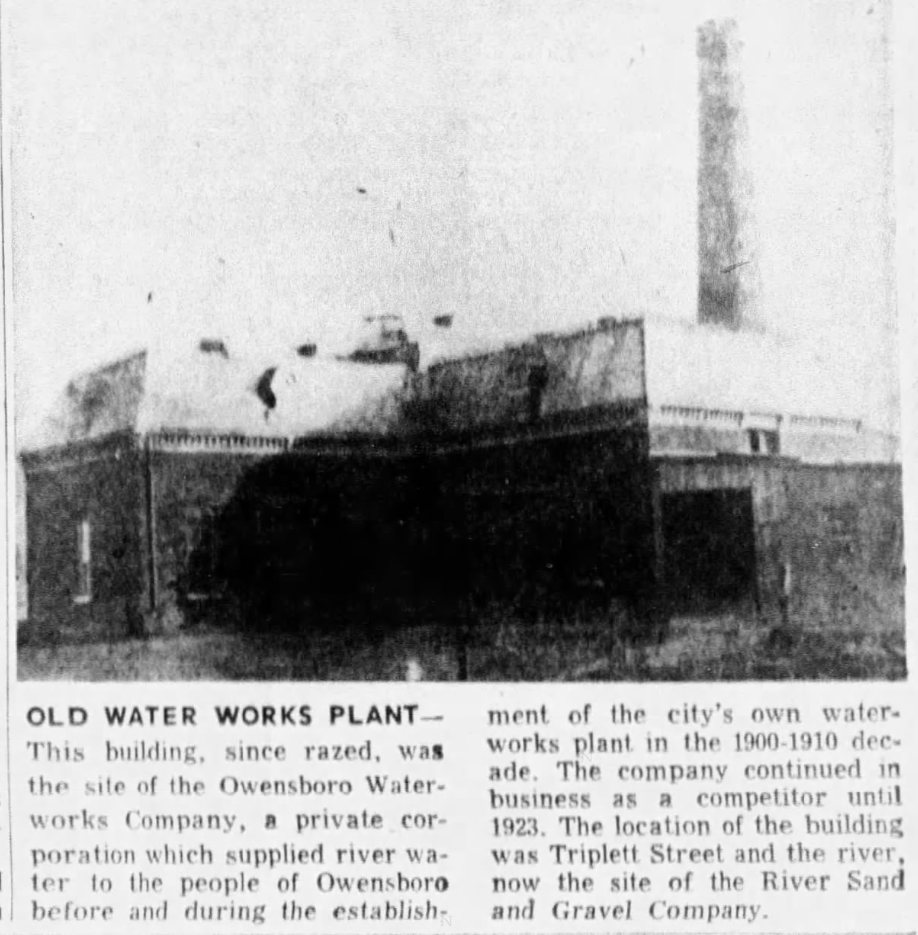
Another photograph showed the old Owensboro Water Works Company building — the private plant that had been the city’s rival for two decades. The caption noted it had since been razed; its location at Triplett Street and the river was now the site of the River Sand and Gravel Company.
Growth Through the Late 1950s
By 1960, the water plant’s average daily output had reached 4,700,000 gallons, recorded by 13,732 meters — a dramatic increase from the 2,700 meters in service just 28 years earlier. The plant, observers noted, “seems to have an inexhaustible supply of well water, and there is no concern now of the wells ever running dry.”
Part IV: Expansion and the Modern Utility (1970–2021)
The 1970s Expansion
In April 1971, Owensboro Municipal Utilities launched a major expansion program that included new wells, extended distribution lines, improvements to water treatment, and a sludge-disposal system. The upgrades were designed to raise production capacity from 14 MGD to 20 MGD, meeting the needs of a growing population and expanding industrial base.
Equipment-delivery delays pushed the anticipated completion beyond 1973, but construction progressed steadily. Financing came through a bond issue approved earlier in the decade, supplemented by grant applications to the Department of Housing and Urban Development. The expansion marked Owensboro’s transition into a fully modern public utility.
Well Infrastructure Challenges (1977)
By 1977, the sustainability of the well system itself was in question. Independent geologist James F. Howard submitted a report warning that portions of the city’s 27-well network were being over-pumped, with one well near failure. His survey concluded that 21 of the wells — most more than 20 years old — needed replacement.
The most promising new water sources lay near the Ohio River and along East Fourth Street, where thick Ice Age sedimentary deposits provided excellent aquifers. However, these areas contained high concentrations of iron, calcium, and magnesium that complicated treatment.
Howard recommended rotating pumping schedules and replacing one well per year at an estimated cost of $45,000 each. OMU responded by preparing to open bids for new well construction. The commission also authorized a new maintenance facility at the Elmer Smith power plant to comply with OSHA standards. On the financial side, OMU was managing the refinancing of a $53 million bond issue from 1970, to be repaid through 1995.
County Demand and Regional Negotiations (1987–1989)
By 1987, rapid growth in surrounding county water districts had begun to strain the system. Nearly one-quarter of OMU’s 20 MGD capacity was going to customers outside city limits. General Manager John Pace explained that the increased demand came from long-term contracts with three county districts serving parts of Daviess, McLean, Ohio, and Hancock counties.
Estimates for a new treatment facility ranged from $10 million to $30 million. Not everyone agreed on the urgency. Jan Kuegel, who managed both the Southeast and West Daviess County Water Districts, pointed out that the contracts allowed districts to terminate with two years’ notice — a provision that could leave OMU financially exposed if it built an expensive new plant and then lost its largest rural customers.
By 1989, negotiations that had seemed headed for litigation shifted toward compromise. The original expansion proposal placed roughly seventy percent of the cost on rural districts, which objected. Bill Cavin, chairman of the city’s Utility Commission, proposed an annual review system where each district’s share would be recalculated based on actual consumption rather than projections.
Joe Riney, chairman of the West Daviess County Water District, endorsed the approach: the districts were willing to pay their fair share as long as costs were tied to real growth. The compromise avoided legal conflict and established cooperative regional planning that would guide Owensboro’s water management going forward.
The New Treatment Plant and a Near-Catastrophe (1994)
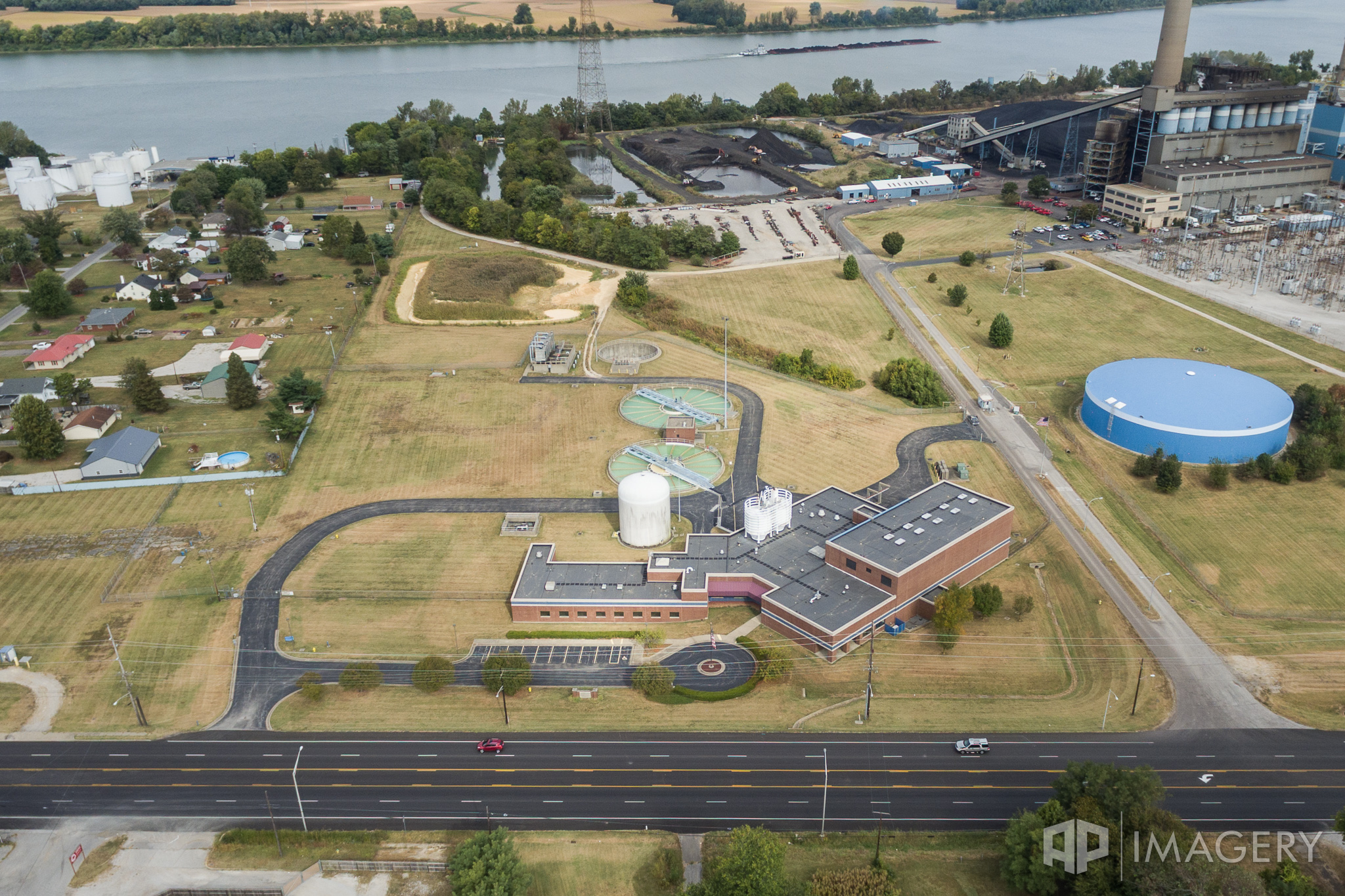
By the early 1990s, construction was underway on a new estimated $20 million water treatment plant along U.S. 60, next to the Elmer Smith Station. OMU implemented incremental rate increases to fund the project, including a six-percent adjustment in April 1994 that raised the average monthly residential bill by $0.56, from $8.72 to $9.28. General Manager Bob Carper noted that conservation efforts by large industrial customers, while commendable, had reduced water sales and created a revenue shortfall.
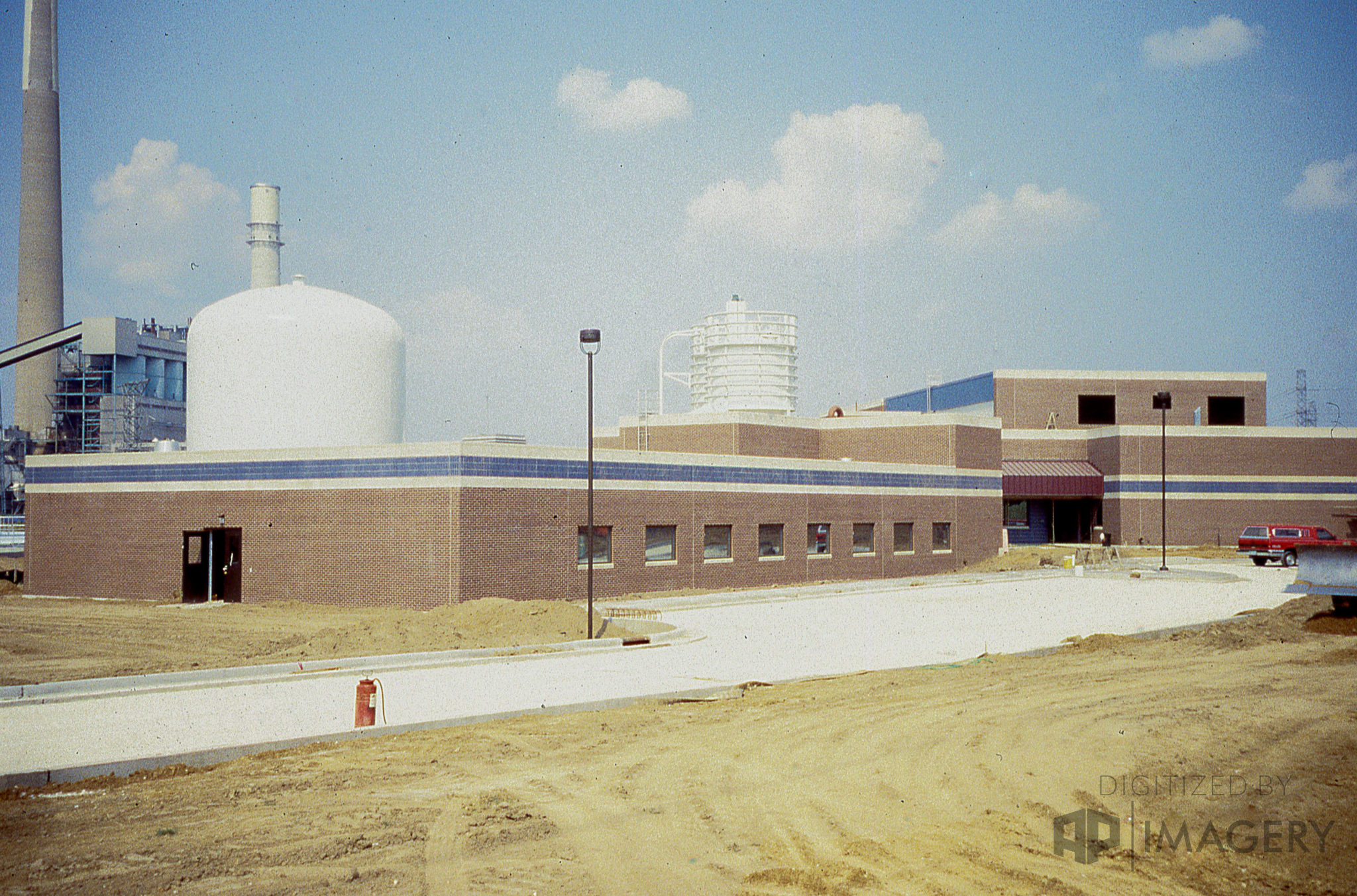
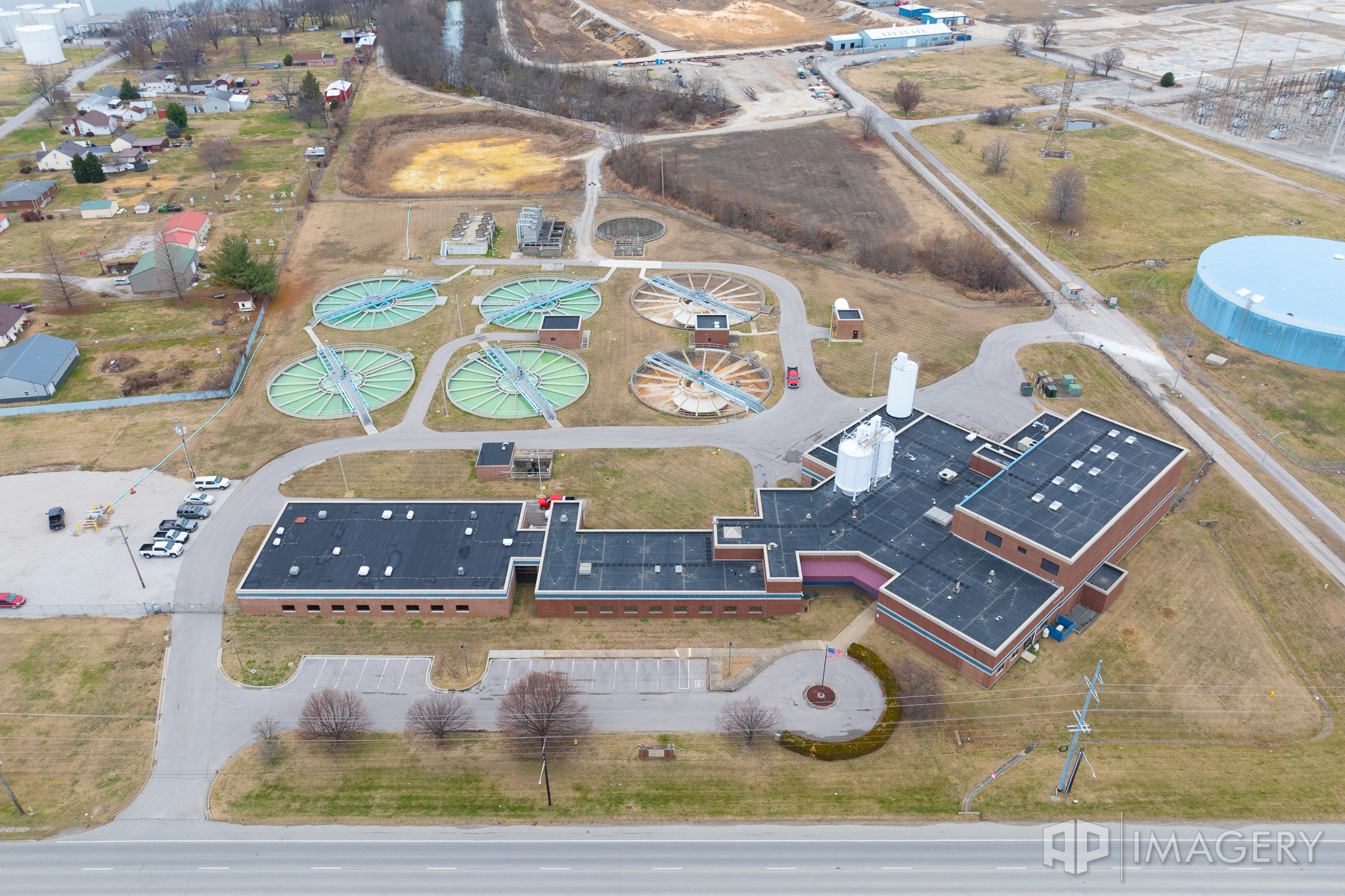
The new plant was designed to produce 10 MGD, with room to expand to 40 MGD. By spring 1994, construction was 75 percent complete. Water Superintendent Claude Brown reported testing of individual systems would begin by the end of July. The facility featured a red-brick exterior accented by a band of blue glazed brick.
Then, in August 1994, weeks before the new plant was to open, disaster struck.
A massive pre-dawn rupture in a 57-year-old water main sent hundreds of thousands of gallons flooding into city streets, cutting off water to much of Owensboro. Crews worked 19 hours to repair the break, restoring flow by 10:15 P.M. — but the water was declared unsafe to drink until at least Thursday. Both city and county governments declared a state of emergency. More than 100 Kentucky National Guardsmen were deployed to distribute bottled water.
The outage affected more than 50,000 residents. Industries shut down, restaurants and businesses closed, schools delayed opening. With hydrants out of service, fire officials staged tanker trucks across the city. The event underscored the vulnerability of aging infrastructure and the critical importance of the new plant’s redundancy.
Dedication of the Bill Cavin Water Treatment Plant (October 1994)
By October, the new facility was complete and officially dedicated as the Bill Cavin Water Treatment Plant, honoring long-serving Utility Commission chairman and retired Army Reserve colonel William “Bill” Cavin. At a luncheon commemorating the event, Cavin expressed surprise and gratitude, acknowledging the years of planning and cooperation that had made the plant possible.
The dedication also highlighted OMU’s environmental work. A sulfur dioxide scrubber was being installed at the nearby Elmer Smith Station to meet requirements of the 1990 Clean Air Act, with completion expected by 2000. OMU opened both the water plant and scrubber project to public tours.
Awards, Aging Infrastructure, and the Case for Expansion (1997–2017)
In 1997, OMU earned four major awards at the Kentucky-Tennessee section meeting of the American Water Works Association. The Cavin Plant was honored for excellence in operations. Lead operator Herman Cecil was recognized for his presentation on computerized water treatment. Laboratory technician Stephanie Stickler won for her paper on nitrification in the distribution system. And Jody Wassmer was honored for OMU’s public-education program “Power for Pennies.”
But beneath the accolades, infrastructure challenges were mounting. In February 2003, OMU proposed a rate increase to fund system upgrades: raising the monthly customer-service charge from $1.50 to $2.25 and applying an eight-percent hike for commercial users. The expected $250,000 in additional annual revenue would support a new west-side water tower (partially funded by a state grant), filtration improvements at Plant A, major storage-tank repairs, and new wells. General Manager Bob Hunzinger, who had succeeded the retired Bob Carper, explained that water sales had been flat for nearly a decade.
By 2013, the reckoning arrived. Water Director David Hill reported serious structural problems at Plant A — the original facility first built in 1906 and expanded in 1973. Foundation settlement had cracked concrete and steel framing. Engineers warned the building could be vulnerable to seismic activity. OMU evaluated two options: a $37.7 million stabilization or a $47 million expansion of the Cavin Plant.
In 2015, GRW Engineers formally recommended abandoning Plant A and expanding Cavin from 10 MGD to 30 MGD. The project would take about 3.5 years and require a 20 to 25 percent rate increase — roughly five dollars a month for the average residential customer. Plant A’s deteriorating pipes, tanks, and roofing made renovation impractical. City Utility Commission Chairman J. T. Fulkerson supported the recommendation, and General Manager Terry Naulty emphasized that modernization was essential for future reliability.
The urgency became undeniable in 2017 when a 20-inch cast-iron main burst at Plant A. The pipe — nearly 80 years old — failed at a weakened seam, flooding the area and triggering a widespread boil-water advisory. Schools and businesses closed. OMU shifted operations to the Cavin Plant, but at only 10 MGD capacity, it struggled to meet the region’s 12–13 MGD demand. The incident renewed public pressure to proceed with expansion.
The Cavin Expansion and the Retirement of Plant A (2018–2021)
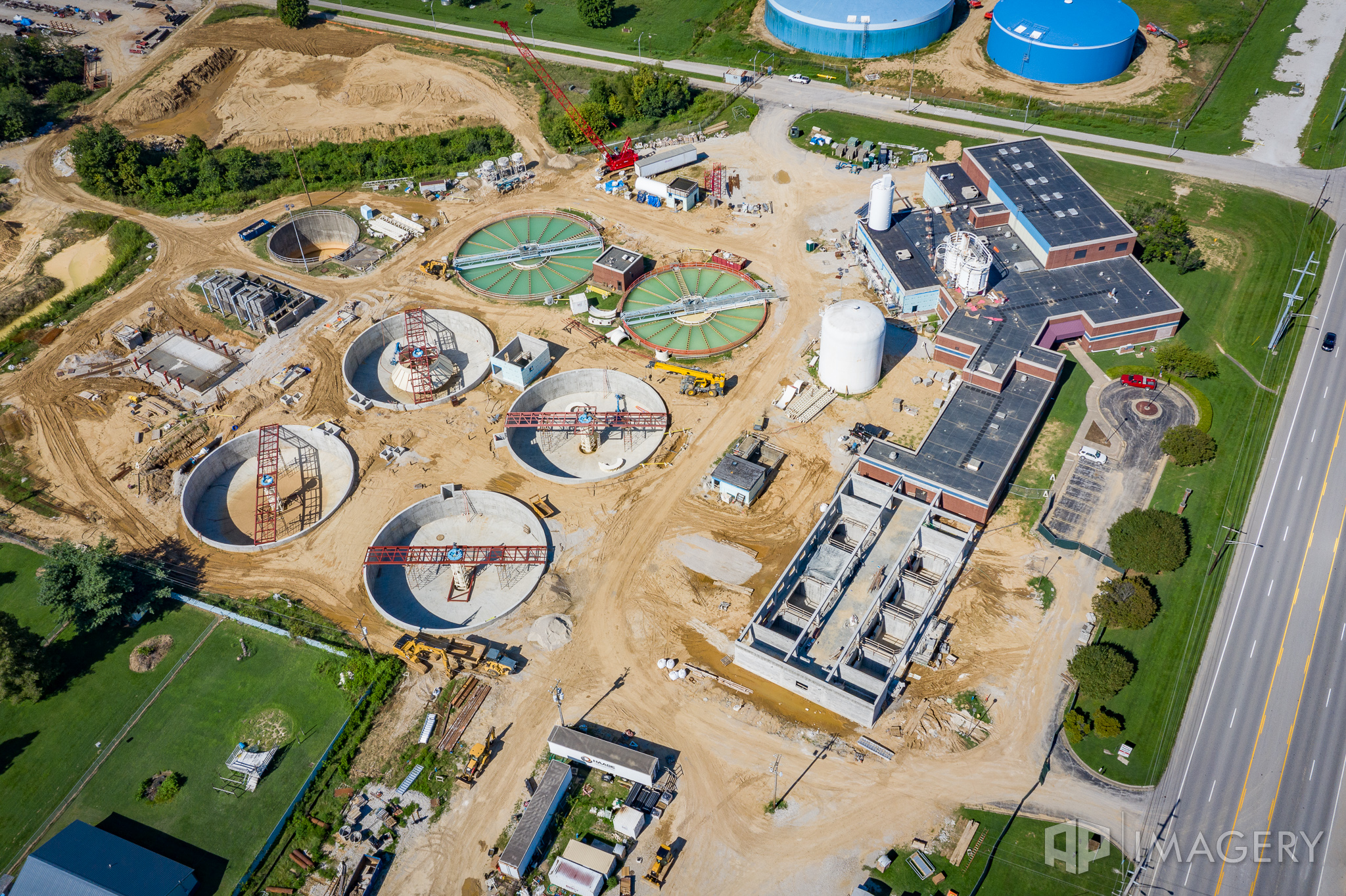
In spring 2018, OMU awarded a $39.7 million contract to Bowen Engineering Corporation of Indianapolis for the primary expansion and a $6.7 million contract to Garney Companies, Inc. for new transmission and sludge lines — a total project cost of $45.7 million. Rising prices for rebar, steel, and other metals pushed costs above initial projections, though contingency funds from Plant A’s decommissioning kept the project within budget.
Interim General Manager Kevin Frizzell oversaw the contracting. OMU selected Garney over lower bidders based on its strong record in large-scale water projects and safety performance. Lexington-based W. Rogers Co. submitted a proposal but was excluded due to a longer timeline.
The expansion tripled the Cavin Plant’s capacity, adding new filtration systems, water clarifiers, and aeration facilities. To finance the work, OMU and its partner districts had implemented rate increases in the years leading up to construction — some districts raising rates by as much as thirty percent. The utility also secured over $60 million in financing, a portion used to refinance older bonds, saving ratepayers roughly $1.7 million over time.
Construction remained on schedule and within budget through 2020 and early 2021. City customers had absorbed a 32 percent cumulative rate adjustment, while county districts implemented similar increases.
By May 2021, the expanded Cavin Plant was fully operational.
On July 6, 2021, at 8:10 A.M., Plant A — after nearly 115 years of continuous service — was officially taken offline.
Conclusion
From the evening in 1878 when Dennis Long stood in the Daviess County Courthouse and promised a city of cistern-drinkers that he could deliver clean water through iron pipes, to the morning in 2021 when the last valve at Plant A was closed for good, the story of water in Owensboro spans 143 years of ambition, frustration, legal combat, engineering ingenuity, and civic determination.
It is a story of a private company that made grand promises and failed to keep them — of fire hoses running dry while city blocks burned. It is a story of citizens who voted overwhelmingly to take control of their own water supply, of a city clerk who refused to sign the bonds and was overruled by the courts, and of young professionals in their thirties who served on unpaid commissions because they believed public utilities belonged to the public.
It is a story of workers — engineers at 50 cents an hour, laborers at a quarter — who kept the pumps running through the Depression and two world wars. Of chemists who traveled the Ohio River in a floating laboratory testing for typhoid. Of a softening plant, the third of its kind in America, that transformed hard well water into something the ice factories could be proud of.
And it is a story that is not finished. The Cavin Plant now stands as the sole source of treated water for Owensboro and the surrounding region — a modern facility built to serve the community for generations to come. The 75 names on the bronze plaque at the old plant are a reminder that public infrastructure is never the work of one person or one era. It is built, maintained, debated, expanded, and rebuilt by each generation in turn.
Owensboro’s water system is the product of all of them.
